Reading the Land: What Soil Health Reveals Beyond the Surface
As part of delivering conservation programs, NRCS field staff regularly conduct practice verifications. These visual inspections take us directly to the land to confirm practices are installed and functioning as intended, whether that means evaluating a prescribed burn in a forested tract or quickly checking that a cover crop was established and providing adequate ground cover.
Earlier this month, I brought two new NRCS field office employees out to a producer’s field in Wake County, North Carolina. We were there to conduct an in-depth soil health assessment, a process that let us slow down and spend more time evaluating ground conditions than my typical cover crop checks.

I had been to this exact field earlier in the spring to verify their winter cover crop and saw a lush, vibrant stand of crimson clover and triticale. When I see a cover crop that strong, I always imagine the producer is set up for a great season.
Returning to the same field in September, I was confused and dismayed. The field was overgrown with weeds, and the standing corn looked sparse; if it hadn't been planted in clear rows, I might have mistaken it for volunteer corn left over from previous years. It was clear the field had been abandoned for the season and would yield no harvest.
The pieces began coming together. When I spoke with the producer on the phone the previous week, he mentioned brush-mowing another crop field (instead of harvesting it) and made a passing comment about crop insurance.
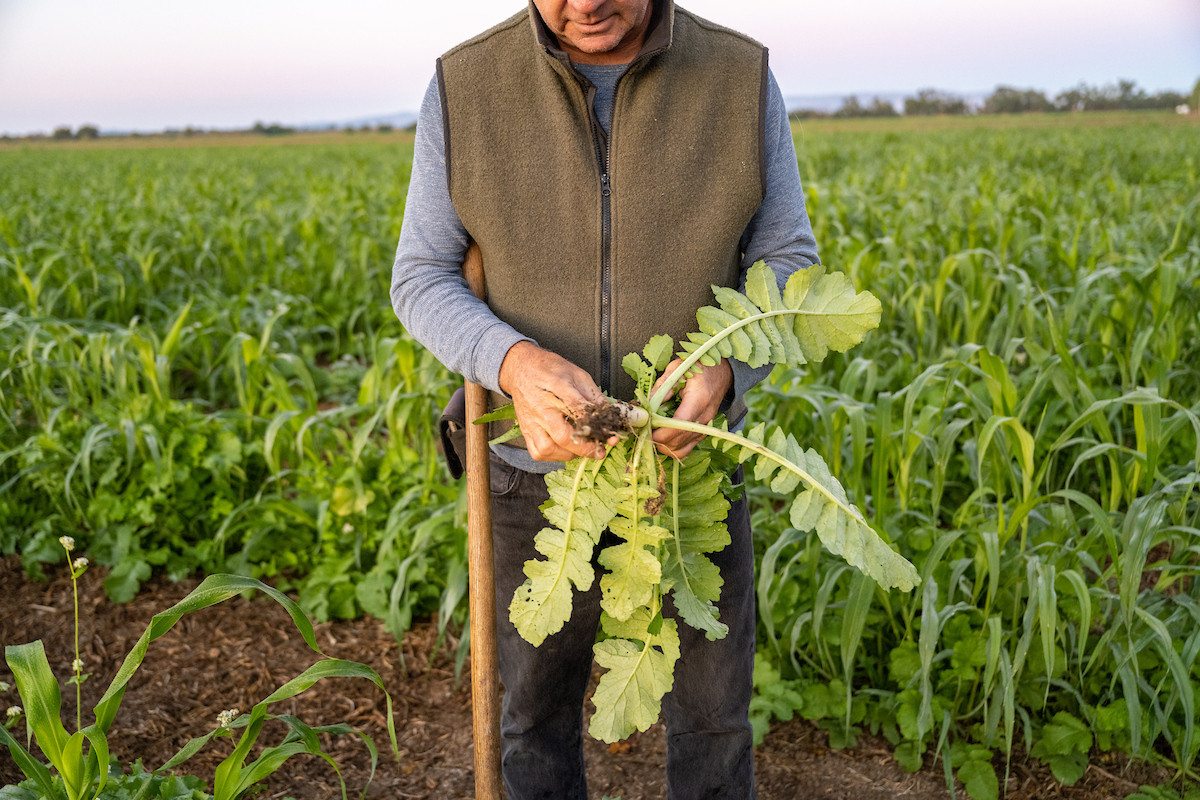
As I stood there with the two new field staff, looking out over the weeds and sparse corn, the lesson for the day instantly shifted. Except perhaps in the dead of winter, you can walk onto a field at almost any time during the growing season and read a story in it. We weren't just going to run through a standard checklist; we had to stop, take a minute, and figure out what this field was telling us.
The broader context played a big role: North Carolina has been dealing with extended drought conditions since last fall. That persistent moisture deficit was a major factor in why this crop didn't make it, compounding every stressor on the land.
Beyond our visual assessment, we needed to gather field data, including slope, management history, and tillage operations, for soil erosion modeling. Moments like this reinforce why paying close attention to field details matters. While an abandoned, weed-covered field is a clear financial loss for the producer, those details carry weight when modeling soil dynamics. The unmanaged weed growth likely provided unexpected ground canopy cover to help protect soil from heavy rain events. Furthermore, brush-mowing the unharvested corn and weeds would eventually return biomass, organic matter, and nutrients to the field that harvest would otherwise have removed.
The field held one more critical lesson about soil history. Web Soil Survey – the USDA’s digital soil mapping database – mapped the area as a sandy loam texture. However, when we hand-textured the surface soil together in the field, it clearly came back as a sandy clay loam. We paused to discuss why the digital map and physical reality didn't match. The likely story? While the producer had cut out tillage in recent production history, years of intensive tillage before that likely churned and mixed clay from deeper subsoil horizons into the topsoil. A common story in many cultivated fields that shows how deeply human management affects nature – pun intended.
Looking past the surface of the crop failure reminded me that every field, regardless of the harvest outcome, has a valuable story to tell. Conservation technical assistance isn't just about verifying practice compliance to release a payment – it’s about learning to read the field, understanding the legacy of the soil, and supporting producers as they navigate challenging growing conditions.
Program Spotlight & How to Get Involved
For this producer, the NRCS Cropland In-Field Soil Health Assessment (IFSHA) was a required test for their first year implementing the “planting green” practice enhancement – an advanced strategy where cash crops are planted directly into a living cover crop to maximize its mulching and soil-protective benefits. The IFSHA provides quick, visceral indications of benchmark conditions and progress in building soil health.

Beyond in-field assessments, NRCS offers advanced laboratory testing through the Regenerative Pilot Program (RPP). These quantitative soil health tests give producers concrete data to track their progress. Producers receive financial assistance payments to help offset the costs of sampling and lab analysis when addressing soil and water resource concerns through certain practices as part of their Environmental Quality Incentives Program (EQIP) or Conservation Stewardship Program (CSP) contracts.
To find out more about RPP please visit the link below:
https://www.nrcs.usda.gov/programs-initiatives/regenerative-pilot-program
Ready to read the story of your own soil?
Producers: If you are interested in implementing “planting green” or accessing financial assistance for soil health testing, contact your local USDA Service Center or reach out to American Farmland Trust (AFT). Our teams can help you navigate EQIP, CSP, and pilot program applications to ensure your land is resilient against changing climate conditions.
Supporters: You can help us keep boots on the ground and technical assistance in the field. Learn more about how AFT champions soil health initiatives and protects our agricultural lifelines by visiting https://farmland.org/soil-health-stewards-program