Working Hard for West Tennessee Farmers
Brad Buttrey helps farmers implement conservation practices that enhance soil health, improve water quality, and support human and non-human communities

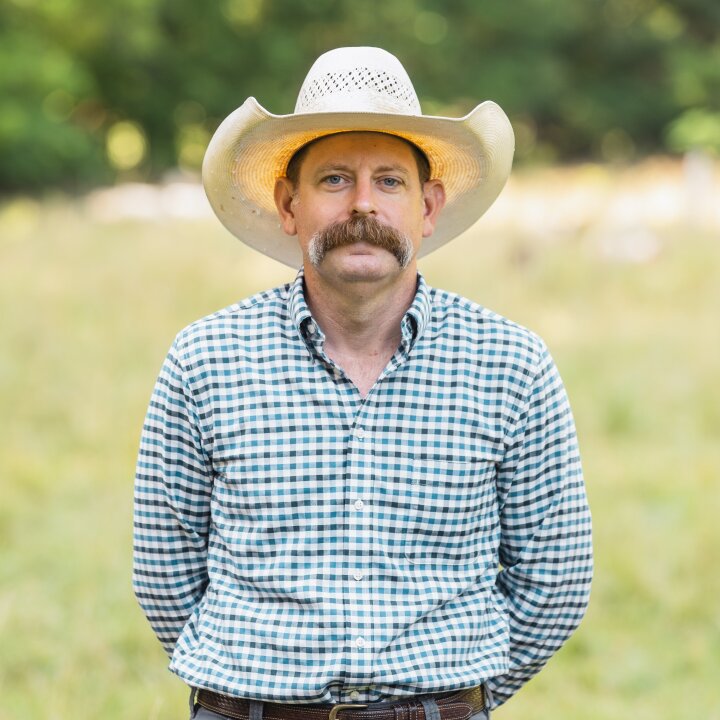
Many farmers in West Tennessee care deeply about their land, and they want to steward it well. Brad Buttrey, American Farmland Trust’s (AFT) newest Southeast Implementation Specialist, helps them achieve their conservation goals.
Through a partnership with the USDA Natural Resources Conservation Service’s (NRCS) Tennessee office, Brad is especially focused on improving grazing management practices in partnership with producers. In this conversation with AFT’s Brooks Lamb, Brad shares what drew him to AFT’s work and highlights the holistic impact of conservation efforts.
Helping West Tennessee’s Farms Thrive
Brooks: Welcome to AFT, Brad! I’m curious about what drew you to the role. Why did you want to work here?
Brad Buttrey: I was drawn to AFT because its mission — to “save the land that sustains us” — resonated with me. As I drive through my home state of Tennessee, the real estate development is staggering. It’s been projected that 1 million acres of farmland in our state will be converted to non-agricultural uses between 2016 and 2040. In more remote areas, I also see many small towns that have “dried up.” These places used to be thriving communities centered around agriculture, and now they’re all but gone. Small and mid-sized farms are being hit hard here and across the nation, and so much of the money from agriculture is being harvested from our rural areas and funneled elsewhere.
Another part of AFT's mission is to keep farmers on the land. As bad as it is to see the ground taken out of agricultural production, perhaps a worse problem is the accompanying loss of people — people who used to love the land and food production. I wanted to be part of a team that is working to reverse that trend. I’ve seen and heard of so many producers across the nation who have found innovative ways to share their farms and ranches with more people, not less. Communities are being built around agriculture, and suddenly one piece of ground becomes a blessing to so many people who previously had no tie to the land. What a great way to steward the land we live on, love our neighbor, and gain allies in our mission! That work matters, and I’m glad to be part of it.

Partnering with Producers and Tennessee NRCS to Advance Conservation
Brooks: Your role is supported by, and in partnership with, the USDA Natural Resources Conservation Service’s Tennessee office. You’re focusing most of your efforts on helping farmers improve their grazing management in West Tennessee. Why is this work important?
Brad: It’s important because the partnership between NRCS and holistic land managers, those who want to see a diversity of life thrive on their operations, is where conservation practices excel.
In my role to help move regenerative practices forward, I think a lot about livestock and their role in our landscape. Well-managed, diverse grasslands and pastures are important ecosystems that benefit so many living creatures, from tiny soil microorganisms to cattle all the way up to the people who live nearby and even far downstream. Stewarding these soils and forages is especially important for West Tennessee, where we have highly erodible soils near the Mississippi River. If producers can get the support they need to implement sound conservation practices in partnership with NRCS, it’ll benefit our soils and waterways — and the producers’ pocketbooks. That’s a much-needed win-win situation where all communities, human and non-human, can thrive.
Brooks: Can you share an example of how you might help a farmer with their grazing practices?
Brad: It could be something as simple as putting another set of experienced eyes on their grazing operation and spitballing ideas. Where should a water tank or cross-fence be installed to better support a managed grazing system? Sometimes these simple questions can lead to deeper conversations and actions that make a massive difference for an operation.
I also enjoy helping producers think through bigger picture ideas. For example, what would it look like if a producer started buying hay instead of making their own? Is there any way they could utilize cover crops or stockpiled forage for winter grazing? If they run cattle, have they ever thought about adding goats or sheep to their operation?
Those are the types of questions that can lead to a meaningful economic impact in a grazing business. Yes, good forage management is important, but I also had to learn that you can’t out-graze a bad business plan. We all have habits in our production systems, and many of those habits are there for good reasons. But some can be unprofitable, so it’s good to have our paradigms challenged and consider new perspectives from time to time. I’m here to help producers with that.
Holistic Impact
Brooks: Thanks so much for this conversation, Brad. It’s clear that you care deeply about your work. Do you have any final thoughts to share?
Brad: Thank you, Brooks. I appreciate the opportunity to discuss this crucial partnership between AFT and NRCS and the work we’re doing to help the people of West Tennessee.
I am invested in this work and its holistic impact because we all benefit from clean food, water, and air. When you take a step back, you can see how regenerative practices and farmland protection can really improve the daily lives of the whole community. Working to support that is very rewarding.
Finally, I’m here to serve the people of West Tennessee. If you’re a farmer who would like to talk about grazing management, or if you’re a conservation partner in my part of the state, please send me a note. I’d love to speak with you. You can reach me at [email protected].
If you’d like to learn more about AFT’s efforts to support farmers in the Southeast region, visit: https://farmland.org/southeast.