Grazing Between the Panels: How Sheep Are Expanding What’s Possible for Solar and Agriculture in Massachusetts
As solar development accelerates across New England, one question keeps surfacing: Can renewable energy and working lands support each other rather than compete? A growing number of farmers — and now a growing body of research — say yes.
A recent study, Sheep Grazing as Sustainable Vegetation Management for Solar Energy Production in the Northeastern USA, published this past August in Frontiers in Sustainable Food Systems and supported by contributions from four AFT staff — Alissa White, Caro Roszell, Kevin Antoszewski, and Emily Cole — found that sheep grazing under solar arrays can improve soil health, maintain high-quality forage, and reduce vegetation management costs for solar companies. This research was led by grazing experts Alyssa Andrew, Lexie Hain, and Jonathan Barter of the American Solar Grazing Association, a national farmer-founded, farmer-led organization that focuses on strategies to advance and promote solar grazing. Zach Goldberg of the Rutgers Eagleton Institute of Politics led the economic analysis portion of the study.

The findings from the study align with American Farmland Trust’s Smart Solar℠ initiative, which promotes solar development that protects farmland, supports farmers, and strengthens rural communities. Smart Solar emphasizes that how solar is designed and managed matters — and that practices like sheep grazing can help keep solar projects compatible with agriculture and long-term land stewardship.
To see how that science holds up in practice, I spent a morning with two Massachusetts graziers — Finicky Farm’s father-daughter team Jesse and Elspeth Robertson-Dubois — who manage more than 250 ewes across ten solar arrays. What they described was not a novelty, but a viable way to produce both food and clean energy on the same land.

A Production Sheep Operation — Not a Landscaping Crew
After years of conventional sheep production, Jesse and Elspeth began solar grazing in 2021 with 21 ewes on two arrays. Today, they steward more than 145 acres of solar and expect to graze close to 600 animals next year, once lambs are accounted for. They raise hair sheep for meat, sell lambs into regional markets, and retain ewe lambs to grow their flock.
From the beginning, solar grazing has been an overlay on a real livestock operation — not a standalone vegetation management service.
“There’s this narrative that solar grazing isn’t production agriculture,” Jesse told me. “For us, it absolutely is.”
Because most Massachusetts solar sites are small — typically 10 to 11 acres — their work is as much logistics as it is farming. Sheep are moved every few days between clusters of arrays along back roads.
“It’s farming, but it’s also a logistics business,” Jesse said. And crucially, it’s one that works: solar grazing provides a stable land base in a region where renting pasture is difficult and buying farmland is out of reach for many beginning and mid-career farmers.
What the Research Found — and What Farmers See Every Day
Better forage, for longer.
In 2023, forage sampled from under panels showed significantly higher crude protein and digestibility than forage sampled in open rows — something Jesse and Elspeth see consistently. Shaded conditions preserve soil moisture and keep grasses vegetative longer into the season.
“Underneath, it’s lush all season,” Elspeth said. “It stays vegetative far longer than our open fields.”
Reduced heat stress and water use.
Solar panels create a cooler microclimate. On hot summer days, sheep graze comfortably in the shade and drink far less water.
“In July, they might drink less than a quart a day,” Elspeth said — a finding that supports the study’s conclusions about animal performance under shaded conditions.
Healthier soils and habitat.
Researchers documented higher soil organic matter and active carbon in grazed solar sites, indicators of stronger soil biological activity. Jesse and Elspeth see improved moisture retention and less compaction compared to mowed-only sites.
“Mowing takes biomass off the field,” Elspeth said. “Grazing puts something back.”
Both the research and farmer experience also challenge assumptions about habitat loss. Pollinators, birds, amphibians, and insects are abundant throughout the arrays.
“It feels a lot like silvopasture,” Elspeth reflected. “Just with metal trees instead of real ones.”

Economics: Why Solar Grazing Pencils Out
A major takeaway from the study was the importance of long-term contracts — something Jesse and Elspeth strongly echo. Most of their agreements span five years, providing stability for both farmers and solar companies.
For farmers, solar grazing offers paid access to land, predictable forage, and a rare opportunity to scale livestock operations in New England. As Jesse put it, “Your off-farm job becomes the same place as your on-farm job.”
For solar companies, grazing delivers stable vegetation management costs, reduced mowing during wet years, lower equipment risk, and a low-carbon maintenance strategy aligned with clean energy goals.
While the study assumed mowing is often cheaper, Jesse disagrees. “If we weren’t competitive, we wouldn’t still have the contracts,” he said.
Transportation — fuel, trucks, and time on the road — remains their largest cost, which is why larger or clustered sites make solar grazing more efficient. That highlights a policy challenge: Massachusetts’ solar program tends to favor small, scattered sites, while agrivoltaics thrives on larger, contiguous acreage.

A Future Where Food and Energy Grow Together
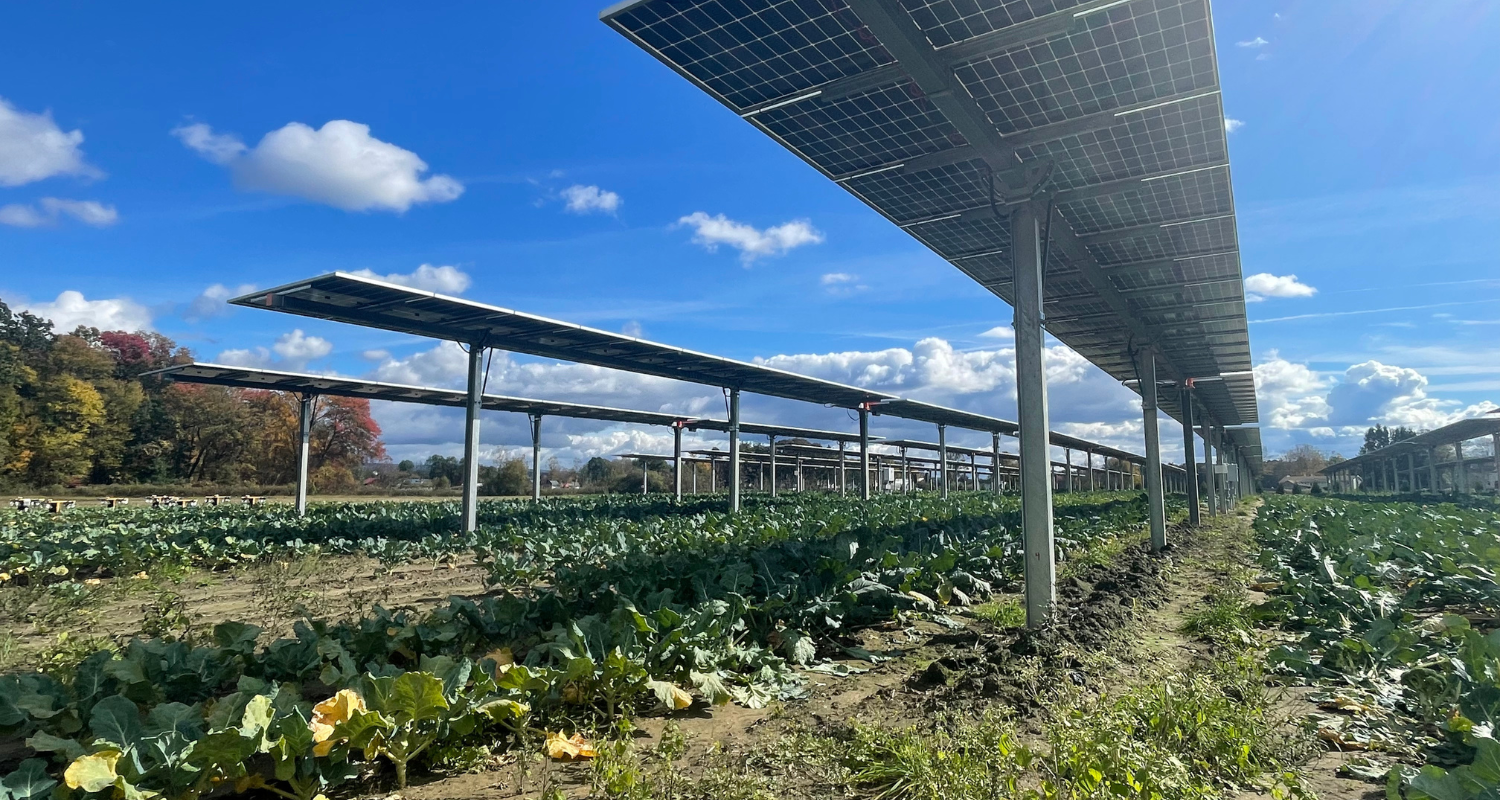
The study underscored that solar design plays a critical role in whether agriculture can thrive alongside energy production. From a grazier’s perspective, Jesse and Elspeth emphasized the importance of adequate panel height, clean wiring layouts, secure perimeter fencing, and access to water. They also pointed to the promise of dual-use systems with higher clearances and wider spacing — including a new 75-acre site they’ll soon farm, capable of supporting grazing, hay production, and other crops.
Despite its benefits, solar grazing remains largely invisible. Even highly visible arrays are rarely recognized as working agricultural landscapes.
“It isn’t speculative,” Jesse said. “It’s happening, and it’s happening nearby.”
He added, “Next year, we’ll be managing land with over 45 megawatts of solar capacity — producing electricity for thousands of homes. It looks like a small sheep farm, but it’s a big deal.”
Solar grazing also reframes concerns about losing farmland to solar, showing how land can remain productive when agriculture is considered from the start. Rather than competing uses, food and energy production can reinforce one another when solar is designed as part of a working landscape.
Solar grazing isn’t just mowing with sheep. It’s a way to grow food, build soil, create habitat, and generate renewable energy at once — stacking functions that point toward the future of New England agriculture. All farming begins with sunlight. Solar grazing simply gives us another way to harvest it.
To learn more about the research behind solar grazing — and how AFT’s Smart Solar℠ initiative is helping ensure solar development strengthens farms rather than displacing them — explore the resources below.