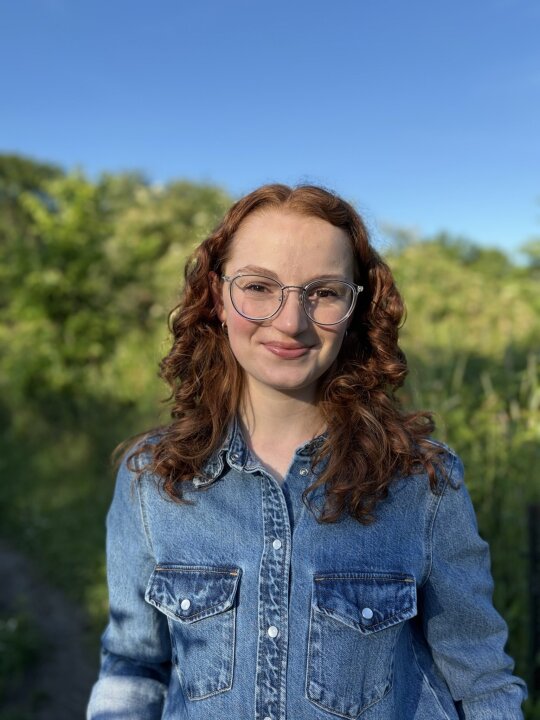
While tabling for AFT’s America’s Farmers Market Celebration™, a Green City Market shopper stopped by our tent. We got to talking about local farms and my work as the Midwest’s new Illinois Farmland Protection Specialist. “How did you get into ag growing up in Deerfield?” the shopper asked me with a confused chuckle.
“Farm camp,” I replied. “I milked a cow for the first time, and I was sold.”
My mom, a journalist-turned-entrepreneur-turned backyard flower grower, remembers leaning on the worn wooden fences at her grandparents’ cattle farm in Florida. My dad, a passionate Chicagoan, recalls mowing his neighbors’ suburban lawns while his mom tended to their small kitchen garden. My parents opted to raise my younger brother and me in Deerfield, a suburb of Chicago where yes, there are a lot of deer but not quite as many fields. I grew up wondering what was going on beyond the fence lines as we drove past farms outside the suburbs.
Harvesting hardneck garlic varieties, summer 2019. The Dairy Barn and Woodshop at Journey’s End. Hanging with the Jerseys and Holsteins on the farm.
The Curtis family and their beloved homestead, Journey’s End Farm, were the stewards behind my earliest experiences in food and farming. I spent my first session at Journey’s End Farm Camp when I was 11. For two of the greatest weeks of my little life up until that point, I waded in creeks, harvested lettuce for camp meals, and combed dust off the ancient donkeys whose brays demanded attention right at the crack of dawn.
Tapping trees at Chatham University’s Eden Hall Farm.
Fast forward about nine years, while earning my degree at Chatham University in Pittsburgh, I opted to spend a summer working on a biodynamic farm in Idaho. My aunt and uncle had lived out west for over 10 years by that point. They opened their guest room to me in an area of the U.S. that is notably short on vital workforce housing. Every morning, I made the short commute from their house across Main Street to a vibrant, magical plot nestled in the shadows of the Tetons. It was at this farm that I was first exposed to agricultural conservation easements and the collaboration these legal tools can foster between non-operating landowners, new-entry farming families, and land trusts.
Left: Harvesting apples with a coworker for cider in Idaho. Right: A pile of piglets born Summer 2022. They didn’t stay this small for long.
The result of this easement was a diversified farm that would not otherwise be viable in an area where real estate values create massive barriers for aspiring growers. The farm grows some of the best produce, and hands down the top tomatoes I have ever had the pleasure of tending to and eating. It provides to farmers markets, fulfills over 70 community-supported agriculture (CSA) shares, and distributes to restaurants and chefs. The family that runs the farm remain valued members of the community who host on-farm events for all ages. I quickly learned that none of this would be possible without the permanent protection of their land.
The past three years have looked a bit different. I haven’t spent as much time on farms. Instead, I’ve found myself more behind-the-scenes working for organizations that support growers, food businesses, and of course, eaters. At Appalachian Sustainable Development, I primarily served the Regional Food Business Center program, a USDA initiative which created 12 centers across the nation to provide technical assistance, award subgrants, and strengthen regional supply chain infrastructure — all crucial moves towards shortened food supply chains.
“Resilience” is a word that gets used frequently, particularly post-pandemic. I couldn’t truly understand resilience until I had the privilege of being brought in on Central Appalachian know-how. In the face of historic disinvestment following the booms and busts of extractive industries, Appalachians know how to take care of one another and of the land. And, they still find the energy to look ahead.
Farm tour of Pittsburgher Highland Farm, a regenerative grazing operation in Appalachia.
One of the most impactful parts of working at Appalachian Sustainable Development was hearing the dreams that farmers, business owners, community members, and fellow staff members shared for the future. Each had their own projects they were already working on, whether that was starting a farm and community arts space with land they had saved up for years to buy from a retiring farmer, or returning to work in agriculture after overcoming addiction and helping others do the same. It was a joy serving Appalachians, and I gained far more than just a taste for chow chow.
Illinois is losing farmland at an extraordinary rate. AFT projects that if trends continue, “363,375 acres of Illinois’s farmland will be paved over, fragmented, or converted to uses that jeopardize agriculture by 2040. That represents an area nearly 2.5 times larger than the City of Chicago and equates to the loss of more than 1,500 farms and 3,400 farm jobs.” On top of this, beginning growers, whether starting out in an urban area or in a long-held farming town, struggle to access land. Plus, established farmers face difficulties holding onto their land as taxes and financial pressures rise.
These challenges are staggering. In my role, I dig into the issues facing farmers and farmland every day. I think about the ways all Illinoisians can foster stronger rural-urban networks. I also assist landowners and entities through the Agricultural Conservation Easement Program – Agricultural Land Easements (ACEP-ALE) in partnership with USDA NRCS. One of the few tools we have for slowing the rate of farmland conversion in Illinois and beyond is agricultural conservation easements (ACEs). ACEs are voluntary, permanent deed restrictions on land that is considered prime for growing. In short, they keep farmland in farming, and they treat farmers as the conservation-minded land stewards we know them to be.
If you are interested in learning more about farmland protection in Illinois, please reach out Charlotte Larson, Illinois Farmland Protection Specialist, at [email protected].



.png)