
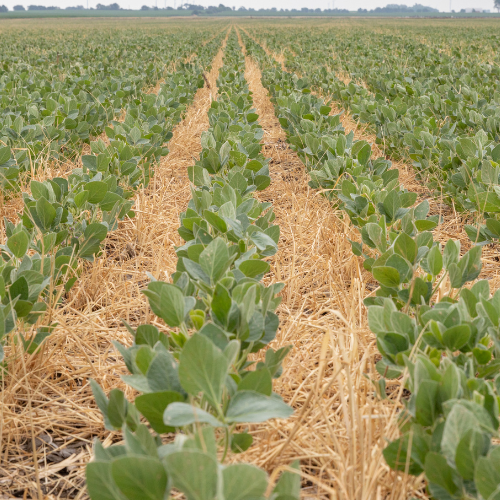
In 2025, American Farmland Trust (AFT) launched the Batch & Grow Cover Crop Program. This unique funding model, available to Farmer-Led Advances in Soil Health (FLASH) group members, puts farmers at the forefront of decision-making. By joining together to share knowledge of conservation practices, farmers shape this program into one that best suits local needs.
Through a Natural Resources Conservation Service Regional Conservation Partnership Program (NRCS-RCPP) led by the Sand County Foundation, all costs of seed and application are covered for participants. By removing these financial barriers, farmers are encouraged to try a new approach to cover crops without taking on added risk if things don’t work out. Because custom seeding is coordinated by AFT with support from local organizations, time and labor constraints are also reduced for participants. In a recent survey, 86% of farmers stated that Batch & Grow removed barriers to the adoption of cover crops for them.
As one Jo Daviess County farmer stated, “Implementation is often the hardest part when it comes to considering a new practice. This program removes some of that concern.”
“Implementation is often the hardest part when it comes to considering a new practice. This program removes some of that concern.”
Over the past year, I built connections with FLASH groups across Illinois to help more farmers benefit from this program. This fall, Batch & Grow participants are planting over 14,000 acres of cover crops, up from 8,000 last year. A total of 87 farmers are participating across seven groups, an increase from 62 farmers across five groups in 2025.
Through the growth of this program, the FLASH groups have gotten the chance to try something new:
Farmers chose to try out different cover crop species, like kale, forage collard, and vetch, to see what benefits they bring. Some groups selected crop mixes well-suited for grazing or wildlife.
Some have expanded beyond the custom drone and/or drill seeding offered last year: one group is trying out aerial seeding with planes, and several groups are giving farmers the opportunity to drill their own seed. This level of experimentation can be difficult to justify when farmers are footing the bill, but Batch & Grow provides more flexibility by removing the financial burden.
One Clinton County farmer shared, “This program allows me to try new seed mixes and application [methods] without added costs.”
.jpg)
.jpg)
.jpg)
.jpg)
.jpg)


.jpg)